Radical Hope #10: When the Flock Moves, Who Is Leading?
You are a body that thinks.
You are nature.
You are the field of awareness in which everything happens.
Not having the answers, you attune to the intelligence of the world.
In Newsletter 9 we learned to witness the field — to open to the field with not-knowing, to witness before we act.
When coherence moves in the world, you move too.
This is the tenth newsletter in a series called From Generative Practice to Radical Hope. I am exploring why deep personal development — somatic, psychological, contemplative — is not a retreat from the polycrisis but the very ground from which genuine engagement becomes possible.
Today, moving into action.
A murmuration of European starlings gathered above the marsh this evening: thousands of birds rising in small groups from hedgerows and fence lines, forming a dark, speckled cloud against the last pale strip of sky. Each carried its own momentum as they drifted into a broad, unruly formation, the air holding that cool, dense, and unusually quiet stillness that often precedes a strong display.
As numbers grew, the flock tightened. A ripple passed through the mass, a subtle wave of adjustment travelling across every wing. Density shifted; folds formed and dissolved, testing the elasticity of the flock's shape. A slight lean at the outer edge became a long, sweeping turn, answered almost before the eye could follow.
Movement settled into softness — continuous reorganisation, bodies threading past bodies with precise, fluid spacing. As dusk deepened, descending streams formed, guiding the flock toward the reed beds where the geometry resolved into quiet, compact clusters for the night.
We have spent nine newsletters learning to listen for that kind of movement. Today we ask what it means to join it. And, sometimes, to begin it.
A murmuration of climate activists
I remember stumbling onto the first Extinction Rebellion occupation of Waterloo Bridge in the heart of London on 15 April 2019 and spontaneously joining in — activists had turned the bridge into a “Garden Bridge,” trees and music and skateboard ramps where traffic should have been. (1) It seemed like a small island of coherence highlighting the urgency of climate change. I wanted to join it and flock with it.
XR uses a decentralised, sociocratic structure: small autonomous circles, each attuned to the wider purpose, linked so information and momentum move quickly through the whole movement. (2)
I stayed with the movement for three years, training others in non-violent action. Then, in the early autumn of 2022, the zeitgeist tightened: British Prime Minister Liz Truss approved forty new North Sea oil fields and lifted the fracking ban despite the seismic risk. (3)
Some of us flocked to a newer organisation, Just Stop Oil, and promised to sit in the street until arrested.
On 25 October 2022 I lay in the road outside 55 Tufton Street, which is funded through a network of opaque donors and “dark money” and has financed British Members of Parliament associated with climate science denial or obstruction.(4,5,6)
My arm was locked inside a metal tube to a fellow protestor to make it harder for the police to arrest me. Above me, a London plane tree rose into the dusk. A single leaf drifted down from a hundred feet, and I caught it — a moment of the sacred, spontaneously unfolding.
I was held overnight, tried, and found not guilty based on the European Convention of Human Rights. (7) But I found I couldn't square the tactics with the ordinary people we were alienating — one slow-motion march brought screams of outrage and pushing and shoving from commuters just trying to get to work.
I watched the flock split around me. Some held to the same tactics. Others, like me, felt the pull toward something else. I stopped putting my body in the road and started training people for what came after it — how to hold themselves in a magistrate's court — and stood, some weekends, as a safety steward on marches the police themselves had agreed to.
Just Stop Oil hung up its hi-vis jackets in early 2024. (8)
Then, in July 2024, the field shifted again: the incoming British Labour government halted new North Sea licences altogether. (9)
Movements, like ecosystems, have their own rhythms. They gather, crest, and sometimes fragment — one coherence splitting into several, each carrying a different piece of what drew us in the first place. Some movements last a season. Others hold their shape for a lifetime. In the next newsletter, we'll meet one that took sixty years.
What I lived through in those years was not only political action. It was participation in a pattern larger than myself — one that looked uncannily like the behaviour of starlings.
Align, stay connected, and avoid collision
Flocking (10), schooling, and swarming emerge from a small set of relational principles — align with neighbours, stay connected, and avoid collision — rather than any central command. The system's coherence arises from interaction, not instruction.
The Flocking Cycle
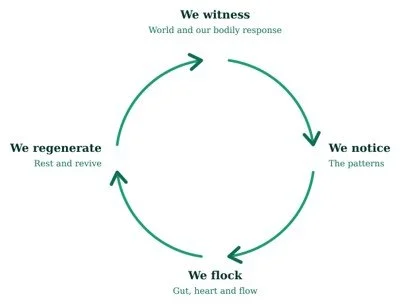
We witness
Not just the outer world — a bird, a fashion, a headline — but our own body too: the gut-tightening pulling away, or the pulled-forward feeling that says something here is alive.
We notice the pattern
Those patterns that are the difference that makes the difference — perceptible enough to register, novel enough to stand out, consequential enough to change us or the system. (11)
We flock towards coherence
Our guts and heart (with a little sense check with the head) instinctively move us towards coherence. This spontaneously emerging action is called acting from non-action (wei wu wei, 為無為) in Taoism, arising from the flow (Tao, 道) of the present moment.
We regenerate
The old shape loses momentum and rests. The out-breath needs the in-breath: it's a natural cycle. Yang, 陽, active, carries us out into the world; yin, 陰, receptive, carries us back into quiet. Gut, heart and the flow of the present moment find their way there before the head is asked.
Witness again — repeating the cycle
We witness to discover how things have changed, and in time a new pattern, a new difference that makes the difference, emerges — and we flock with it.
Let's go into each of these steps in a little more detail.
1. We witness
Newsletter 9 was about witnessing — taking in the whole and the precise detail at once, without one erasing the other. We explored Bateson's difference that makes the difference: the one that changes the system.11 We engaged in the hardest form of listening — staying present to the people whose politics disturb us most, without losing our own ground.
Linda Hartley puts it more plainly: “Just paying attention: what do you notice in your body? It might be the breath, a pain in your back, something else.” (12)
2. We notice the pattern
Kathleen Dameron's practice is to watch a film from another culture — different actors, a different director — and notice how people walk, how close they stand, how they touch, how they show love, how food appears and disappears from the frame. (13) Once you have noticed the pattern in someone else's culture, it becomes possible to notice the equivalent pattern in your own — otherwise invisible, like water to a fish.
We also watch for our own confirmation bias: the assumptions we carry without knowing we carry them, which let us see what confirms what we already believe and pass over what does not fit.
In my twenties, I noticed that young men got kudos for taking women to bed, while women were shamed for the same thing — and it took me a few years to untangle myself from that double standard.
The same nudge that vanished without trace yesterday can create a new future
Noticing the pattern isn't only about what's moving — it's about the state of the field itself. When the old order can no longer hold, a small act that would once have vanished without trace can turn the whole system over. (14)
So the real question isn't “will my action make a difference?” It's “what state is the field in?” As Steve Paxton put it: “Go beyond small to the place where no message is being given. Start there. Let small be the first of the pleasures to come.” (15)
3. We flock towards coherence
A conspiracy of decency
On the night of 1 October 1943, the Nazis planned a lightning raid to deport every Jew in Denmark, timed for the eve of the Jewish New Year so they would be at home. But when the soldiers came, the houses stood empty. A warning had leaked, days earlier, from inside the German administration itself.
What happened next had no plan behind it. No committee met. No leader gave the order. Fishermen, shopkeepers, doctors and priests — tens of thousands of ordinary Danes, most of whom had never met each other — began hiding their Jewish neighbours and ferrying them across the water to Sweden. Each person acted on what was immediately in front of them: a family who needed a cellar, a boat that could make the crossing tonight. Within days, almost the entire Jewish population of Denmark was gone from under the noses of an occupying army. Almost all of them survived the war.
A whole country turned in a single night.
Rutger Bregman calls this a conspiracy of decency. (16) I'd also call it a flock — though the two aren't the same. Bregman's phrase does moral work: decency, conscience, doing the right thing. The flocking model does structural work: local rules, no leader, emergent coherence. Flocks form around cruelty too — mobs flock, panics flock.
What made this one decent was the altruism people brought to it when the signal arrived.
4. We regenerate
Regeneration is what happens when you stop trying to solve something and let it settle. You attend to something else: perhaps restful, nourishing, or simply pleasurable, and let something deeper than thought do the rest.Sometimes it's a night. I turn an idea over and over, going in circles — then let go and sleep on it. By morning it's clearer. (17)
Sometimes it's a week or two, set down and not touched.
And sometimes it's a season: in 2024 I walked five hundred miles through the Pyrenees, sleeping mostly in a tent for three months. I wasn't thinking anything through — just my feet, my breath, the weight on my back, the next horizon. I kept no notes about my future. Nothing was being solved up there. I was allowing not-knowing.
G. Spencer-Brown put it more starkly: “To arrive at the simplest truth... requires years of contemplation. Not activity. Not reasoning. Not calculating... Not thinking. Simply being in mind what it is one needs to know.” (18)
Sacred Uselessness
For busy people, especially activists, it matters to rest without an agenda (19): the Buddhist teacher Dayajoti calls this sacred uselessness.(20) Not resting in order to perform better, but simply being present, with nothing to achieve. Your being is the justification for your existence. (21)
5. We witness again
In our regenerative sacred uselessness, we are, of course, naturally, spontaneously and unintentionally witnessing and participating in the world.
We are curious to see how the field has changed. In time a new pattern stirs, a new difference that makes the difference — and the cycle repeats.
Why Does This Matter Now?
Newsletter 5 asked you to trust your body.
Six and seven asked you to feel yourself as nature, as awareness itself.
Eight showed how your own coherence changes the field around you.
Nine asked you to witness before acting — to let the world speak before deciding what it means.
All of this deep work is part of an inner process emerging into the world.
We are living through a moment when breakdown and breakthrough are both possible, or perhaps some combination of both. Breakdown is the compost out of which breakthrough can grow.
With the world unstable, small acts are acquiring large consequences. Old orders are visibly failing to hold, and new ones have not yet found their shape.
This is not a comfortable place for us to stand.
But it is exactly the condition under which a signal for change can move through a whole system: a country, a movement, a life. The listening we have been practising heightens our sensitivity to the signals that matter.
Noticing the differences that make the difference, moving with them, and knowing when to rest afterwards — that cycle is what this newsletter is about.
A Practice
Take some reflection time.
Enjoy your systems consciousness embodied awareness for a few minutes.
• What are you witnessing in the world that disturbs you?
• Are there any glimmers of growing coherence that you are curious about?
• Checking with your gut and heart, is there any interest in following your curiosity and finding out more?
• Might there be a feeling of safety, connection and solidarity if you approached other people with the same concerns and curiosity about possible moves towards coherence?
Next Newsletter: How is Life Calling you?
We have learned to listen — to open to the field with not-knowing, to witness before we act. We have learned to move — to sense when to join what is already moving.
Next time, the in-breath becomes the out-breath. We become aware of how life is calling us. Sometimes we are called to be the one that moves and a flock forms and follows.
Everything received so far asks to be lived, not privately, but in developing and giving your particular gifts to the world. Making your difference in the world. As you understand what calls you, develop your mastery and empowerment, perhaps you will be someone who sometimes moves with the flock, and other times finds yourself leading.
How has this newsletter touched you?
What is moving in your heart?
If something has resonated, or troubled you, do write to me: julian.russell@lifetalent.com. Also write to me if you want to join our WhatsApp and participate in the discussion.
Are you on the mailing list for the next newsletter and updates? If not, click the link above.
In hope and love
Julian
Julian Russell is a psychotherapist, executive coach, writer, and committed fellow traveller through the territories of inner work and public life. Drawing on decades of somatic and contemplative practice, he helps people access the capacities they already carry. He is a co-founder of the Generative Citizen community — a gathering of people who understand that how we are matters as much as what we do. His forthcoming book, Standing at the Edge of Hope, explores why personal and spiritual development is not a retreat from the world's crises, but the very ground from which transformative engagement becomes possible.
Notes
1 The Guardian, “Extinction Rebellion Turns Waterloo Bridge into ‘Garden Bridge’ with Trees, Plants and Music,” 16 April 2019.
2 Across the world, movements have organised through small, connected groups rather than central command. The Zapatistas in southern Mexico built autonomous Indigenous councils rather than a single leadership. Hong Kong's 2019 pro-democracy movement adopted a deliberate “be water” strategy — no headquarters, no leaders to arrest, action flowing to wherever it was needed. Fridays for Future began with one striking teenager outside the Swedish parliament in 2018 and spread through thousands of independent local groups, with no central office directing any of them. On the pattern of networked, leaderless organising across contemporary movements, see Manuel Castells, Networks of Outrage and Hope: Social Movements in the Internet Age, 2nd ed. (Cambridge: Polity Press, 2015).
3 BBC News, “Liz Truss Lifts Ban on Fracking and Announces New North Sea Oil and Gas Licences,” 8 September 2022.
4 OpenDemocracy, “Revealed: The Think Tanks at the Heart of the Tufton Street Network Receive Millions in Dark Money,” 5 October 2022.
5 The Guardian, “Tufton Street Thinktanks Received Funding from US Groups Pushing Climate Denial,” 11 November 2022.
6 BBC News, “What Is 55 Tufton Street and Why Does It Matter?,” 14 October 2022.
7 Westminster Magistrates’ Court, Ruling on Public Order Charges, 26 October 2022, referencing Articles 10 and 11 of the European Convention on Human Rights.
8 BBC News; The Guardian; Sky News, “Just Stop Oil winds down disruptive campaign,” 2023–2024.
9 BBC News, “Labour Confirms Halt to New North Sea Oil and Gas Exploration Licences,” 12 July 2024.
10 Craig W. Reynolds, “Flocks, Herds, and Schools: A Distributed Behavioral Model,” Computer Graphics 21, no. 4 (1987): 25–34. Reynolds' seminal paper introduces the three canonical rules — alignment, cohesion, and separation — showing that flock-like behaviour emerges from simple local interactions without central control.
11 A difference, for Gregory Bateson, is any variation in the world; a “difference that makes a difference” is one that a living system registers and is changed by — perceptible to the system, novel against its existing patterning, and consequential enough to alter its state. He introduced the formulation in his 1970 lecture “Form, Substance and Difference,” collected in Steps to an Ecology of Mind (Chicago: University of Chicago Press, 1972).
12 Linda Hartley, somatic educator and founder of the Institute for Bodywork and Movement Therapy, in conversation with the author, 14 April 2026.
13 Kathleen Dameron, management consultant, in conversation with the author, 14 May 2026.
14 Ilya Prigogine and Isabelle Stengers, Order Out of Chaos: Man's New Dialogue with Nature (New York: Bantam Books, 1984). Prigogine's work on dissipative structures showed that systems held far from equilibrium can lose stability at a critical threshold — a bifurcation point — beyond which small fluctuations can determine which of several possible new states the system settles into. The practical upshot, for anyone deciding whether to flock: the same small act has wildly different consequences depending on the state of the system. In a stable system, a perturbation dies out. Near a bifurcation point, an identical perturbation can turn the whole thing over.
15 Steve Paxton, talk at Steve Paxton: Drafting Interior Techniques, Culturgest, Lisbon, 9 March 2019; excerpted in Contact Quarterly (2022). Paxton (1939–2024) was a founding figure of Contact Improvisation and a member of the Judson Dance Theater.
16 Rutger Bregman, “A Conspiracy of Decency,” Reith Lectures 2025: Moral Revolution, lecture 3, BBC Radio 4, broadcast 2025. The book Bregman takes the phrase from is Emmy E. Werner, A Conspiracy of Decency: The Rescue of the Danish Jews During World War II (Boulder, CO: Westview Press, 2002). Georg F. Duckwitz was a German shipping attaché in Copenhagen who, on learning of the planned deportation, warned Danish political contacts, who in turn alerted the Jewish community. Bregman puts the survival rate at almost 99 per cent; the figures usually given are that of roughly 7,000 Danish Jews, 461 were deported to Theresienstadt, of whom most survived and later returned. What united the rescuers, across differences of class, education, religion and politics, was that none of them considered themselves heroes.
17 If you are trying to solve a problem, dropping an intention about it into your morning meditation can support the unconscious process working on it overnight.
18 George Spencer-Brown, Laws of Form (London: George Allen & Unwin, 1969), epilogue. Transcribed by Julian directly from his own copy of the text.
19 Barbara Fredrickson's broaden-and-build theory of positive emotions proposes that joy, interest, and love temporarily broaden our thinking and perception, making us more open, flexible, and exploratory; over time, these states build resilience, social connection, and cognitive capacity. Barbara L. Fredrickson, “What Good Are Positive Emotions?” Review of General Psychology 2, no. 3 (1998): 300–319.
20 Dayajoti gave a talk on 17 July 2026 on “Sacred Uselessness” at the Buddhafield Festival, based on what her teacher Sangharakshita described as “the mandala of complete uselessness” — his interpretation of the teaching on the Greater Mandala of Aesthetic Appreciation. Sangharakshita, The Inconceivable Emancipation: Themes from the Ratnaguna-saṃcayagāthā (Birmingham: Windhorse Publications, 1995).
21 A contradiction worth naming: saying this supports a deeper state of relaxation implies sacred uselessness is useful — exactly the attachment to usefulness it asks us to let go of. Notice that attachment, and do nothing about it.