Radical Hope #12: A Different Way to Think About Justice
From Generative Practice to Radical Hope #12
You are a body that thinks.
You are the field of awareness in which everything happens
You are nature
You are not separate from the suffering of the world.
As I open to the field and the world, I feel more pain.
I have discovered that I can balance this with joy by frequently turning to the beauty of the world: flowers, sunshine, weather and the amazing uniqueness of every human being — their personality, their history and their ancestral story.
I practise gratitude, building a habit of saying “I am grateful for…” whenever I notice another loveliness.
The beauty of the world helps me find the resources to hold a space in myself for suffering.
So does love.
As a child, I learnt that safety was being self-sufficient — to pretend I needed no one.
As I heal, I realise how much I need people.
As my heart opens, this extends beyond family and friends. I danced last night and there were so many moments of genuine meeting: a woman recovering from long Covid, whom I had never met before, gently leant on my shoulder as we sat in a circle. Moments of mutual recognition with swans on the river, and dogs on the banks.
As I connect more with the beauty of the world, as nature nourishes me, as I surrender to love — the more I am able to contain the suffering of the world without dissociating or distracting myself. Just to be clear, I am also learning to be loving to myself when the need to dissociate and distract becomes so strong that I surrender to it.
In the last newsletter, How Is Life Calling You?, I explored how a person finds their calling; how giving your gift becomes a path of mastery, how the in-breath of attention becomes the out-breath of committed action.
But life does not only call us towards our gifts.
It also calls us to meet the world’s wounds.
We watch atrocities unfold abroad while, at home, the democracies we relied upon wobble from within. Our screens fill with suffering and injustice that demand we take a stand.
And yet something in us knows that the familiar patterns of blame and counter-blame have never once broken these transgenerational cycles of pain.
So how do we answer that call without adding to the very harm we long to end?
This is the twelfth newsletter in a series called From Generative Practice to Radical Hope. I am exploring why deep personal development — somatic, psychological, contemplative — is not a retreat from the polycrisis but the very ground from which genuine engagement becomes possible.
My Skin in the Game
This matters to me in my bones.
I had German Jewish cousins who were gassed in Nazi concentration camps. I also had cousins who were ethnic Germans, living out their old age in Berlin during the Second World War.
After the war, survivors of the Holocaust said, “Never Again”. I have taken those words as a vow — bowing to my ethnic German, Jewish, British and Irish ancestral lineages, all of them.
I cannot make an enemy of a whole people. I can only name a harm.
And it isn’t enough to name harm.
We also need to name the vision of what peace could be — Nelson Mandela dreamed of “a rainbow nation at peace with itself and the world” (1).
None of this protects you from receiving harm yourself.
I have been called an antisemite more times than I can count, for standing up for Palestinians and for Gaza. Naming a harm as precisely and as carefully as I know how has still made me enemies.
Nelson Mandela had enemies for twenty-seven years, until the government that jailed him decided he was the best hope it had.
So this is not a technique for being liked.
What is ours to choose is whether we live by our values and stand for them in the world, and do everything we can to stay in connection.
And of course, each of us, myself included, is on a learning curve. We cannot expect perfection. How people respond to this is theirs.
Justice Is How Love Moves in the World
Something extraordinary is available to us in this time.
We have been exploring how somatic psychology lets us release the burdens our body has carried for decades, sometimes across generations; and how postmodern approaches to ancient spirituality return us to our own nature — awake, alive, luminous.
And as we taste that freedom,
we discover something the individual mind alone could never tell us:
we are not separate from the suffering of others.
As we open to discovering ourselves as nature, as the world,
as the space in which everything arises,
we dissolve the illusion that we were ever separate at all.
Justice, then, is not a political obligation added on from outside. It is the natural expression of an awakened heart.
Justice is how love moves in the world.
Here is the knot at the heart of it.
Can we name illegal, violent and unjust behaviour for exactly what it is — and still feel for the communities the perpetrators come from?
Seeing the Whole and the Part at Once
Newsletter 9 asked you to sit somewhere busy and let your attention widen until you held the whole field — and then to differentiate, to pick out one person, one small group, without losing the whole.
That movement is not a meditation exercise. It is what justice asks of us.
Collective blame is what happens when the part disappears into the whole: one man’s crime becomes stereotyped as his people’s nature.
The opposite blinds just as badly — when the whole disappears into the part, and we see only the harm, never the history that produced it, never the people inside that community already risking everything to resist it.
To hold both at once is not a moral achievement. It is a perceptual one — and it is the attention we have been practising all along.
Wisdom asks one more thing, which we also met in Newsletter 9: not-knowing.
Naming a harm precisely and still not knowing — still holding that we might be missing something — is far harder than either certainty or silence. The moment we name a harm we are in danger of a subtler one: the quiet conviction that we stand on the right side and they on the wrong. That righteousness is its own kind of blame. Not-knowing is what keeps accountability from curdling into the thing it opposes.
Wisdom, in a system, is the capacity to hold many points of view at once. Justice is that capacity under pressure.
It happens in a boardroom as much as in a war. The colleague you have decided is that sort of person. The neighbour whose politics you found out and stopped being curious about. It is much easier to see collective thinking in other people than in oneself.
What I Did to My Brother
When I was six or seven I got into a fight with my twin brother Stephen about whether my lion was king or his teddy bear was king.
I got so angry that I hit him over the head with the handle of a hobby horse. The handle was wooden and pointed. He was rushed to hospital with a hole in his skull, and carried a small bald spot on his scalp ever after.
I wish I had not done it. I do not defend it. I regret it still.
And I can also see where it came from. I was a wounded and neglected child, and Stephen’s illnesses brought him our mother’s attention in a way that being a “good boy” never did.
Understanding my woundedness does not justify what I did. But it does let me love myself, rather than think of myself as a bad person.
The Hardest Place to Practise This
In the late nineteen sixties and early seventies our newspapers were full of aircraft hijackings by the Popular Front for the Liberation of Palestine. A few years later, a Belgian diplomat I met at a party offered to introduce me to a Palestinian woman from a well-known Jerusalem family.
I was nervous. Would I be associating with a terrorist? What was I getting myself into?
She had been educated at an English private school and spent much of the year in London. She was self-sufficient and independent. And her family had held one of the keys to the Church of the Holy Sepulchre since Saladin retook Jerusalem in 1187 — appointed as neutral guardians precisely because the Christian denominations inside could not agree among themselves who should hold it. Her family have opened that door nearly every morning for eight hundred years. (4)
I could feel her woundedness at the way the world judged Palestinians in those years. My picture of a whole people fell apart in an afternoon.
Any population contains many peoples.
So let me try to hold all of it at once.
I can see the harm in Gaza, and the injustice in the West Bank and East Jerusalem. I can see the trauma carried by Palestinians since the Nakba, when they were driven from their homes at the founding of Israel.
I can also see centuries of antisemitism, pogrom, massacre and genocide across Europe and the Soviet Union. I know people whose parents did not tell them they were Jewish until the Soviet Union ended and escape to Israel became possible — because to be known as a Jew had been a social disadvantage, and at times a danger. I understand the deep ancestral longing for a homeland. I feel it.
I know, from the psychology of trauma, how traumatised people act their trauma out on others.
And I know that some of the strongest advocates for social justice anywhere in the world have been Jewish, and that many Israelis want peace and work for it at real cost.
None of that justifies harm.
Nothing justifies the slaughter of the young people at the Nova music festival on 7 October 2023. (2) Nothing justifies the killing of women and girls, and of children, in Gaza for over two years. (3)
Whatever the trauma, behaviour has to stay within commonly accepted norms — which is what a hole in my brother’s skull taught me when I was seven,
So I do not blame Israelis, and I do not blame Jews or Palestinians. I name the Hamas leadership, Benjamin Netanyahu and his government, the specific decisions taken, and the settler organisations taking land in the West Bank.
And in the same breath I hold the Israelis who march every week for a ceasefire, and the Palestinian families who have kept a door open for eight centuries.
This is the whole and the part, at the scale where it costs something.
A Generative, Collaborative Approach to Justice
Justice can be approached divisively or collaboratively. And we can focus only on the problem, or also on building the solution.
Those two choices give us four possibilities.
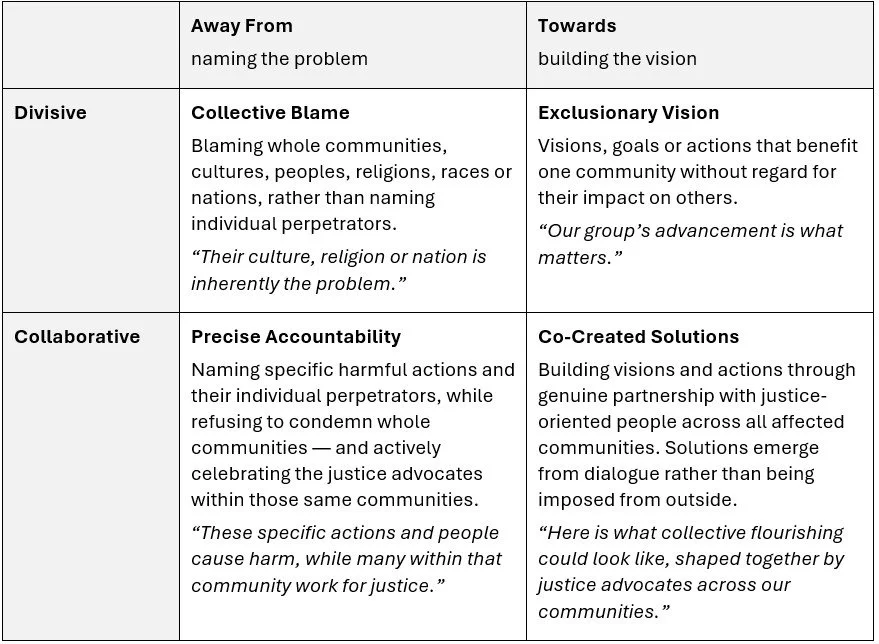
It is the bottom row that is generative — Precise Accountability and Co-Created Solutions. This is the whole and the part, held together.
How the Two Work Together
Precise Accountability happens quickly: we call out the illegal or unethical act soon after it occurs.
Co-Created Solutions take longer; they grow consensus, patiently, about what justice actually asks of us.
A Practice
Name Precisely, Not Collectively
This practice has no set time. It waits for a trigger.
The trigger is a sensation, not a thought. The heat that rises in the chest when the news comes on. The jaw setting. The particular hardening that arrives with a judgement — them, that nation, that faith, that political tribe.
That is the moment. Stop there.
Something in you will resist this. Letting go of the blame can feel like letting someone off, like a betrayal of the people who were harmed. It isn't. Precision is not softness — it is the sharper instrument. You are not putting the blame down. You are taking better aim.
Let your attention drop out of the thought and into the breath. Three slow breaths, or whatever practice takes you most easily into embodied awareness.
Connect with your heart and the field of awareness and hold that difficult feeling with love.
Stay with the sensation a little longer than is comfortable. Where does the blame actually sit? What is its texture, its temperature, its shape?
Then name what is true: this specific person, this specific action, this specific harm.
And a few breaths later, bring to mind the people inside that same community who are working, often at real cost, for exactly the justice you want. If you do not know who they are, it is time to find out.
The shift from “they” to “this person did this, and those people resist it” is small. It is also the difference between feeding the cycle and breaking it.
This will not work the first time. The pull towards the whole group is old and deep, and it will win more often than not. What builds the capacity is frequency, not effort — coming back to it, briefly, again and again, until precision is the first thing that arrives rather than the second.
Next Newsletter
In the next newsletter (no. 13), we explore being an Active Bystander in our family, local community, town and place of work. We look at what actually stops us from stepping in when we witness harm, and what it takes to name it out loud without losing our humanity, or our humility. We also become speakers of vision.
In the following Newsletter (no. 14) we broaden our horizons to the national and the international sphere. How can we flock more fully with movements towards justice as well as a shared vision for humanity and the ecosystem?
Where do I catch myself blaming a whole people, faith or party for the actions of specific individuals?
And where — thinking I know best — might I be adding to the very problem I want to solve?
If something has resonated, or troubled you, do write to me: julian.russell@lifetalent.com. Also write to me if you want to join our WhatsApp and participate in the discussion.
Are you on the mailing list for the next newsletter and updates? If not, click the link above.
In hope and love
Julian
Julian Russell is a psychotherapist, executive coach, writer, and committed fellow traveller through the territories of inner work and public life. Drawing on decades of somatic and contemplative practice, he helps people access the capacities they already carry. He is a co-founder of the Generative Citizen community — a gathering of people who understand that how we are matters as much as what we do. His forthcoming book, Standing at the Edge of Hope, explores why personal and spiritual development is not a retreat from the world’s crises, but the very ground from which transformative engagement becomes possible.
Notes
1. Nelson Mandela, “Statement of the President of the African National Congress, Nelson Mandela, at his Inauguration as President of the Democratic Republic of South Africa,” Union Buildings, Pretoria, 10 May 1994, full text at SAnews (South African Government News Agency), accessed 18 August 2026, https://www.sanews.gov.za/south-africa/read-nelson-mandelas-inauguration-speech-president-sa. The phrase “rainbow nation” was coined by Archbishop Desmond Tutu; Mandela gave it its most quoted form in this speech.
2. At the Nova music festival, 364 civilians were killed; an Israeli military investigation published in April 2025 gave 378, including security personnel. Across southern Israel that day the figures have moved as identification work progressed. Israel’s initial estimate was about 1,400; on 10 November 2023 the Foreign Ministry revised it to around 1,200, explaining that unidentified bodies previously counted as victims were now believed to be those of attackers. In December 2023 an analysis of Israeli social security data gave 1,139 — 695 Israeli civilians, 373 security personnel and 71 foreign nationals, including 36 children. Later compilations put the total at about 1,195. The differences turn on definitions rather than dispute: whether security personnel and foreign nationals are counted alongside civilians, and how long the count stayed open. Two hundred and fifty-one people were taken hostage. I have given a range rather than a single figure because the range is the honest answer, and because a newsletter about precision should be precise about its own uncertainty.
3. As of 31 December 2025, Gaza’s Ministry of Health had identified 71,444 of the 72,619 fatalities it reports: 34,078 men, 21,283 children, 10,983 women and 5,100 elderly. A further 172,484 people were injured. United Nations Office for the Coordination of Humanitarian Affairs, “Reported Impact Snapshot, Gaza Strip,” 6 May 2026, accessed 18 August 2026, https://www.un.org/unispal/document/ocha-reported-impact-snapshot-gaza-strip-6-may-2026/. OCHA notes that these breakdowns cover fatalities the Ministry has fully identified, out of a higher number reported. Gaza’s Ministry of Health figures have been disputed by the Israeli government but accepted by Israeli intelligence, the UN and the WHO. Independent peer-reviewed studies — using capture–recapture analysis and, separately, a population-representative household survey — have found the Ministry’s counts to understate violent deaths by around 35 to 41 per cent, while the demographic composition of the dead closely matches its reporting. The figures given here are a floor, not an estimate.
4. The custodianship of the entrance to the Church of the Holy Sepulchre has been held by two Muslim Jerusalem families — the Joudeh al-Husseini family, who keep the key, and the Nuseibeh family, who open and close the door — since Saladin’s reconquest of the city in 1187. He appointed a neutral guardian because the Christian denominations within the church could not agree among themselves. The two families give differing accounts of their own history: the Joudehs date the arrangement to Saladin, while the Nuseibehs trace their role to the Muslim conquest of Jerusalem in 638 and hold that the Joudehs joined only under Ottoman rule. Eight hundred years, one door, and two versions of the story — which is rather the point of this newsletter. See https://www.cnn.com/2016/03/26/middleeast/easter-muslim-keyholder.